
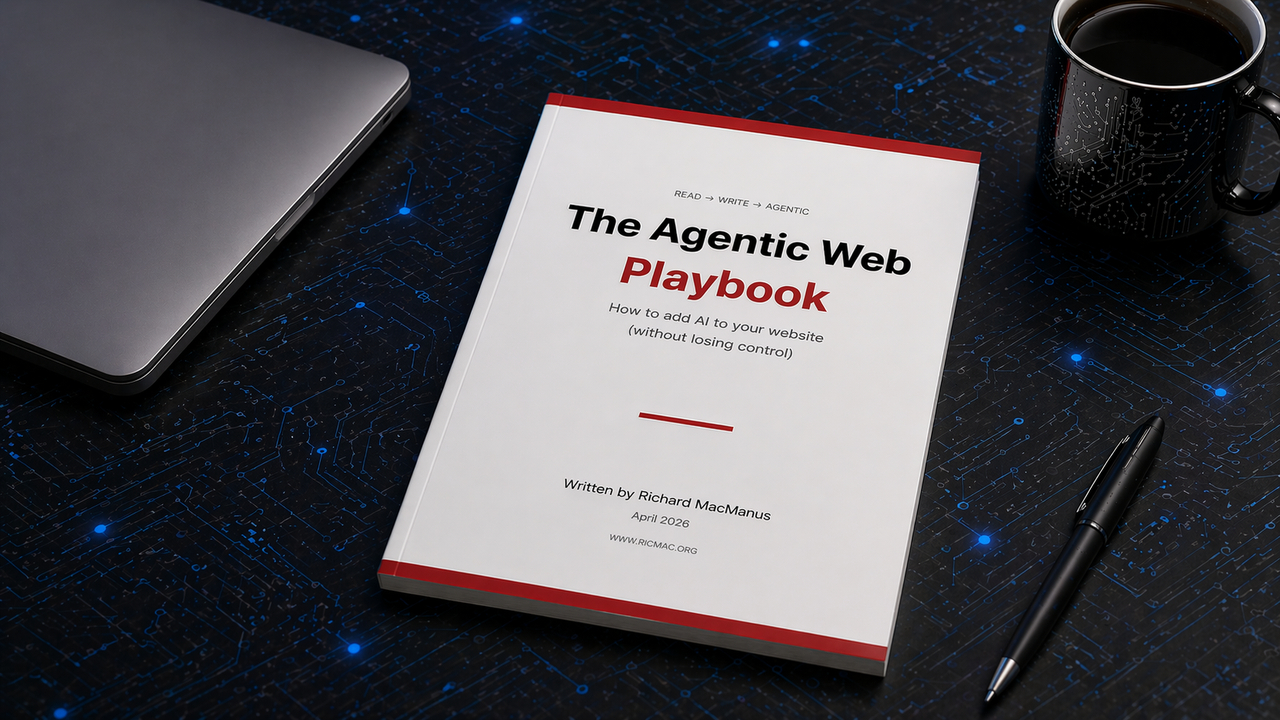
I’ve put together a guide — The Agentic Web Playbook — on how to add AI to your website.
Over the past year, I’ve been thinking a lot about how AI is changing the web, particularly how people actually use websites. Instead of navigating pages directly, users are increasingly relying on AI systems to answer questions, summarize content, retrieve information, and in some cases take actions on their behalf.
I call this shift the Agentic Web: a web where AI agents don’t just read content, but act on behalf of users. In this model, interaction moves away from direct navigation and toward delegation, with AI systems increasingly mediating how people access and use information online.
At first glance, this looks like a threat to websites. If AI sits between you and your users, what role does your site itself play? It’s a reasonable concern, and one that’s often framed in terms of declining traffic or loss of control.
But the more I’ve looked into it, the more I think the opposite is happening.
Websites are becoming more important — not less. They remain the one place where you fully control your content, your brand, and your user experience. In an agent-mediated world, your site is no longer just a destination for human visitors — though that is still fundamental to the web. It also becomes the source of truth that AI systems rely on, and the layer where you define how they work with your content.
Your website as the control layer
Over the past few months, I’ve been exploring the agentic web from both a conceptual and practical perspective. That’s included building an on-site AI “article assistant” and experimenting with local versus cloud-based models in the browser, implementing a protocal called WebMCP to better control how agents use my website, and adding an AI chatbot to my site. I’ve also been paying attention to how different kinds of sites show up (or don’t) in external AI systems like ChatGPT and Perplexity.
One thing that has become clear is that most websites are not designed for how AI systems actually interact with them. They tend to be hard to parse, inconsistent in structure, and not particularly well suited to retrieval or programmatic use. As a result, they either don’t show up effectively in AI outputs, or they are used in ways that the site owner has little control over.
This creates both a risk and an opportunity. The risk is that platforms — whether AI assistants, search interfaces, or aggregators — increasingly sit between you and your users. The opportunity is that your website becomes more important as a control layer: the place where you define how your content is accessed, interpreted, and ultimately used.
How to adapt to the agentic web
My sense is that the sites that do well in this next phase of the web won’t be the ones that rely on external AI platforms, but those that integrate AI into their own products over time.
With that in mind, I’ve created a PDF guide that I hope will be useful to website operators, product managers, and developers. It’s called The Agentic Web Playbook: how to add AI to your website (without losing control).
The aim of the playbook is to be practical rather than theoretical. It looks at the patterns that are starting to emerge — things like on-site assistants, hybrid local/cloud AI systems, and early forms of agent interaction — and explains how they fit together. It also includes a real implementation example (the article assistant I built), along with a checklist you can apply to your own site.
If you’re thinking about how AI is changing the web — particularly from a product, engineering, or content perspective — it will give you a clear starting point.
You can request the playbook by filling in this form:


I’ll then send you the playbook directly by email.
I’m also starting to offer an Agent Readiness Assessment, which is a structured assessment of how AI systems interact with a given site and what to prioritize next. I’ll write more about that separately.
If you do read the playbook, I’d be interested to hear what you think.