

The term “agentic web” can still sound abstract, but this week I saw three very concrete layers emerging: how agents transact, how they take governed actions, and how they identify themselves.
The agentic economy
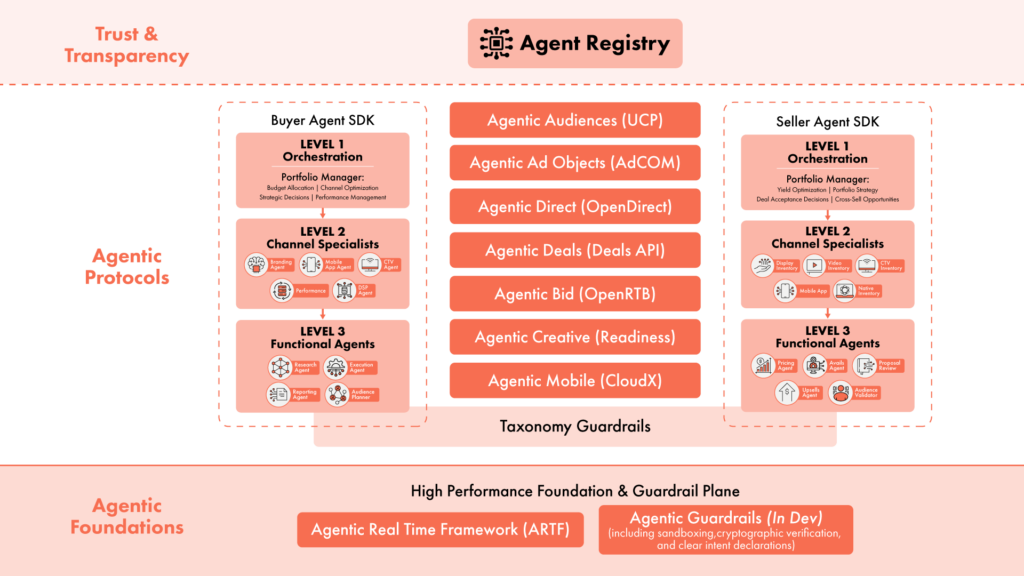
In Monday’s market signals briefing, a weekly feature of my new blog Agentic Web News (AWN), I looked at the trends that emerged from last week’s IAB Tech Lab Summit — which was focused on advertising in the agentic web era. While IAB Tech Lab CEO Anthony Katsur was careful to frame this time as the “wild west” era of agentic advertising — invoking the beginnings of previous web eras, particularly dot-com — it became clear that the foundational infrastructure is starting to be laid down.
The IAB Tech Lab has itself created an umbrella framework called AAMP (Agentic Advertising Management Protocols), which is full of acronyms and ‘agentic’ this-and-thats. Even if some of these pieces fall away over time, it’s encouraging to see the advertising and commerce sectors adapting to agentic AI — getting the monetization machinery ready.
There’s also a ton of experiments and early launches happening among the big players — Amazon, Google, Shopify, Stripe, OpenAI and others. In the AWN briefing, I highlighted Amazon’s new Agentic Shopping Assistant as just one example.
Agentic governance
In an interview published this week on AWN, Arcade’s Alex Salazar told me about his company’s “actions runtime” for agents. The idea is to provide a solid and secure middleware layer, based around MCP, for enterprise companies to manage interactions with agents and AI-ified tools.
Incidentally, Salazar came from Okta — a successful identity and authentication company from the cloud native era of the web. This is another thing I am increasingly seeing: technologists and entrepreneurs running their established playbooks with brand new agentic-focused companies. I’m thinking also of my interview last August with ex-Mashery founder Oren Michels, who now runs an “agentic governance platform” called Barndoor.
Taming the wild west for enterprise use is, of course, a tried and true formula for a new startup in any new web era — hat-tip here to my old Web 2.0 blog buddy, Dion Hinchcliffe, who has always been master of this trend. I know we’ll see a lot more ‘agent governance’ plays emerge as the agentic era ramps up.
Agents and identity
Earlier today I published another interview post, this time with Allie Kline from Innovation Labs (a division of the domain name services company, Identity Digital). This post looked at a crucial question for this era: who owns that agent that just visited your site/app, and who is accountable for it?
Whereas Arcade is focused on how agents execute actions safely, DNSid is focused on a more foundational question: before an agent acts, can we verify who stands behind it?
Again, this is still very early and it’s possible that DNSid won’t become the standard protocol we need. But as I noted in my post, agent identity and accountability will undoubtedly become foundational parts of the open web infrastructure moving forward. It has to be defined in an open standards way, too, because we don’t want the big platform companies to define it for us.
Agentic infrastructure
I always find the beginnings of a new web era to be exciting, because it’s where the infrastructural railroad tracks get laid down. I think we’re seeing real evidence of this now in commerce, enterprise IT, and identity.
I will add there are still areas that are lagging in the agentic web — I keep pointing out the compensation layer for content creators as one of these areas of concern, because it directly impacts me. Also, just like the railways of old, there is a risk of monopolies forming, or becoming even more entrenched, because of AI and agents.
But overall, this is a fascinating time in the evolution of the internet. And that’s exactly why I started Agentic Web News: to track these infrastructure shifts as they happen.