

I had a discussion with someone in the industry this week in which the question came up: what makes something web-based in this AI era? Is it just the presence of web technologies? Or does it have to contain the core elements of the web that was created by Tim Berners-Lee in the early 1990s; for example:
- It’s an open hypertext system on the internet;
- It’s a place where anyone can create a website and publish it;
- It has hyperlinks that allow you to jump from site to site;
- There are broader discovery mechanisms, like directories and search engines;
- The ecosystem has incentives for everyone to participate and that (ideally) rewards created value;
- It’s a massive human network of people, where you can easily find your ‘tribe’.
In that conversation this week with my fellow agentic web traveller, at first I argued that something is web-based if it contains web technologies. To use a modern example, when a graphical user interface is present in an AI chatbot like ChatGPT or Claude, typically it uses web technologies like HTML and CSS.
But the more I’ve thought about it, the more I’ve come to realize that the web is much more than a set of hypertext technologies. That the web is fundamentally a human network.
A toot this week from one of my fediverse buddies reinforced this lesson. Elena Rossini was reading Tim Berners-Lee’s recent memoir, This is For Everyone, and came across the mention of my name:
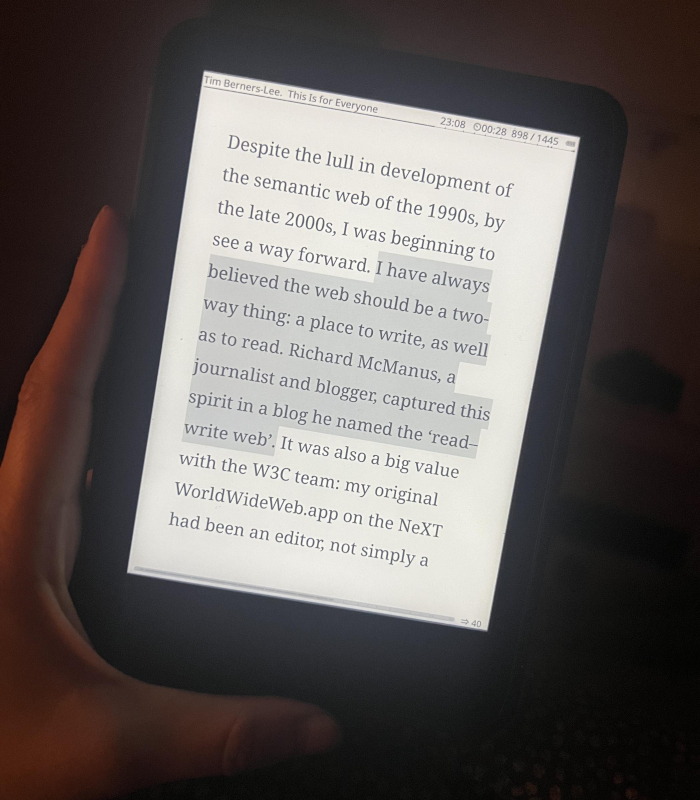
“I have always believed the web should be a two-way thing: a place to write, as well as to read,” wrote Sir Tim. Needless to say, I created my ReadWriteWeb blog based on that very philosophy — that the web is for people to fully participate in, rather than a broadcast media system.
As my blog ramped up and caught the Web 2.0 wave over 2003-2005, it became a bit of a cliche during this time to say that “the web is made of people.” I’m not sure who first used that phrase during Web 2.0, but Ross Mayfield blogged it in September 2005 — around the same time I made my first trip to Silicon Valley, for the second annual Web 2.0 Conference (I ended up meeting Mayfield on that trip).
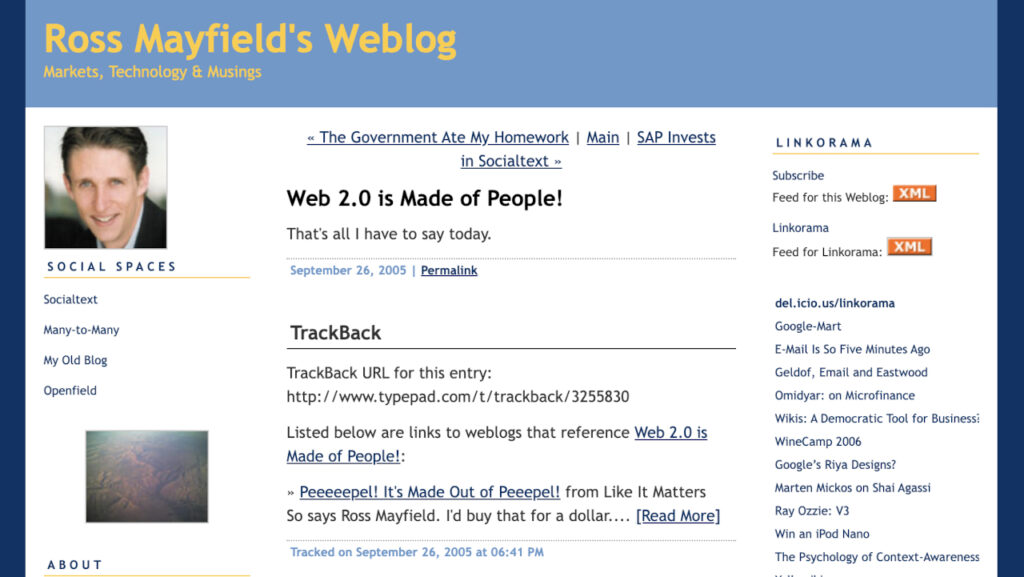
Stewart Butterfield, co-founder of Flickr, was the first to comment on Mayfield’s post: “Fuck – totally!” Other commenters mostly shared that sentiment, but a couple pointed out that “made out of people” was a quote from the 1973 dystopian movie, Soylent Green. According to IMDB:
[last lines]
Det. Thorn: Ocean’s dying, plankton’s dying… it’s people. Soylent Green is made out of people. They’re making our food out of people. Next thing they’ll be breeding us like cattle for food. You’ve gotta tell them. You’ve gotta tell them!Hatcher: I promise, Tiger. I promise. I’ll tell the Exchange.
Det. Thorn: You tell everybody. Listen to me, Hatcher. You’ve gotta tell them! Soylent Green is people! We’ve gotta stop them somehow!
“Web 2.0 is made of people” was often said in an ironic sense during that era — for example this May 2006 post by me. But twenty years later, I think it does capture something important that is missing from much of the present agentic web discourse (and I include myself in this criticism).
The core philosophies of the original web include openness, the two-way aspect of being able to publish as well as consume, hyperlinks, niche networks, and reciprocal incentives. These are all fundamentally human qualities and are crucial to the web’s ongoing survival.
On AI displacing human web makers
In the AI era, I’m especially worried about the incentives of the current tech ecosystem. Are we trying to augment people, as Douglas Engelbart famously aspired to do with hypertext technology, or are we trying to replace people? Of course, I think it should be the former. But that isn’t the prevailing attitude, which is a concern if the web is indeed made of people.
As just one example, this week I came across a new website creation product backed by the famous Silicon Valley startup accelerator, Y Combinator. Ploy is an AI product for marketers — the idea is that you can create a marketing website with just a few prompts, instead of paying human web designers to build and maintain a website for you. The tagline: “Your website should be working harder than you are.” On X, its founder was even more explicit, saying that Ploy is an “all-in-one marketing platform that turns your website into your hardest working employee.”
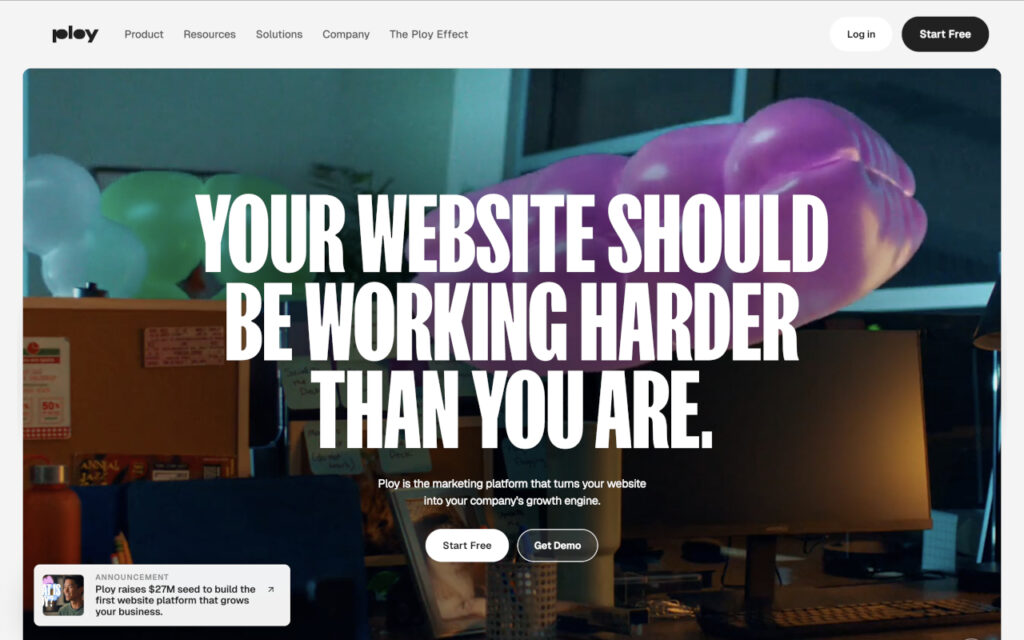
A promotional video from the company drives home the point that Ploy is designed to replace human labour. It shows a young marketer about to leave work for the day, before tapping a few things into her computer, and then leaving the office. We then see some balloon-like AI blobs building a website throughout the night. A night cleaner is the only human present; and he is blissfully oblivious to the AI blobs building a user interface and — for some reason — using the photocopier. The young marketer arrives back at work the following morning to see a fully designed website on her computer, which has even been autonomously emailed to her colleagues and/or clients.

The “hardest-working employee” framing of Ploy treats the website itself as an autonomous worker, rather than as something made and maintained by people. I wonder what the 2006 version of me would’ve thought about that? Probably I’d have wondered how the people-made web can possibly survive if humans are being displaced by machines (although, tbh, I also probably would’ve marvelled at the technology — much like we all admired AJAX and shiny rounded corners back then).
Maybe the human web designers displaced by tools like Ploy in 2026 will find other ways to contribute to and benefit from the web ecosystem. I can speak from recent experience and tell you this isn’t an easy transition to make; my online media job was axed back in February, and I’m still trying to find an income.
Even if web makers and creators adapt, chances are we’ll end up with a lot more generically bland marketing websites as a result of AI design tools like Ploy. Yes, AI can produce websites, just as ChatGPT or Google’s AI Mode can produce answers to your questions (obviating the need for you to click on and read online media publications). But I’d argue it fundamentally weakens the social and creative aspects — the human aspects — of the web platform.
So what is the web now?
To return to the question of what “web-based” actually means in 2026.
From a purely technical perspective, I don’t think there’s a big danger that web technologies will disappear: Ploy produces HTML and CSS websites (most likely with an unhealthy amount of JavaScript), and AI systems like ChatGPT and Claude will use those same technologies to layer in graphic interfaces.
But I’ve come to realize that’s just one part of what the web ecosystem is. What makes the web special is the input from people: how we shape our identities online, how we create and maintain communities, how many of us make a living (or at least try to), how the web enables us to exchange human knowledge, and how it helps us build relationships with other people.
What’s more, the openness of the web is what makes it all work: we can build interoperable sites and link to each other, we don’t need any corporation’s permission to publish, and we can access all voices through open protocols like RSS and ActivityPub.
So yes, the web is made of people! And I for one pledge to keep that top of my mind while building my latest blog: Agentic Web News.
Lead image: from the “Soylent Green is people!” scene; via YouTube